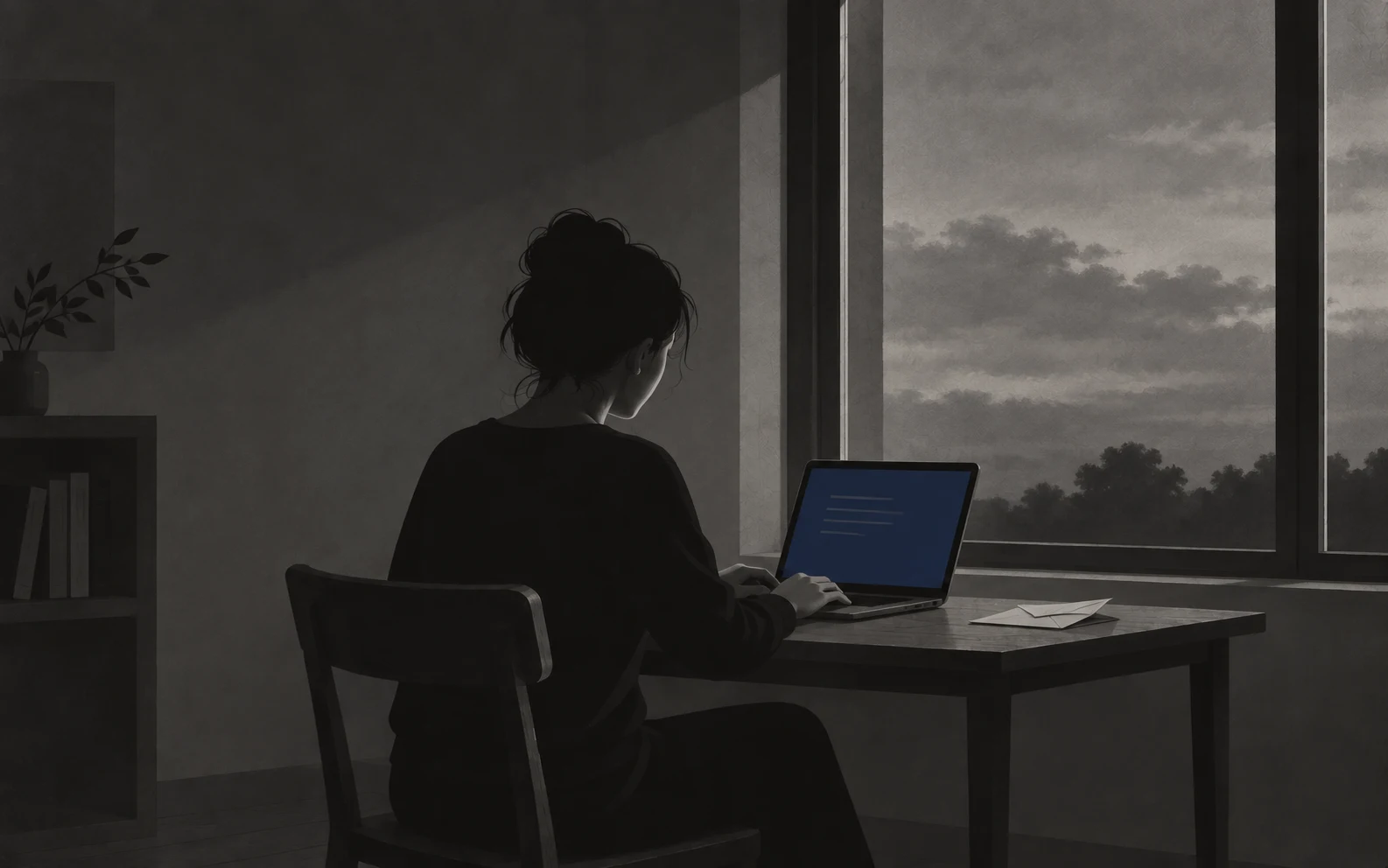
One of the stranger things about writing is that we can change our minds while trying to explain what we think. We begin certain we know what we want to say, perhaps a little irritated that someone else has failed to understand it, and a few lines later we realise the difficulty started earlier. We hadn’t quite understood it ourselves.
It happens with messages we never send. We write a reply, read it back, delete a sentence that seemed essential. The next one, with nothing left to support it, suddenly sounds excessive. We stop. The recipient has received nothing, yet something in the conversation has already changed.
This seems to me an aspect of writing we give less and less weight to. We are used to judging it once it is finished: whether it is clear, whether it persuades, whether anyone reads it. Everything that happened before gets left out. The abandoned sentences, the second thoughts, the aside we added to explain something that, ten minutes later, has become the real reason we started.
Yet some of the value of writing lies precisely there. In the time when the text isn’t ready to be handed over.
When we think back over an argument, for instance, we can revisit it many times while keeping much the same version. We know where to linger, which of the other person’s words to remember, which of our own intentions to take for granted. Trying to write it down introduces fairly concrete difficulties. Where does it begin? What had happened before? Did that sentence hurt because of what it said, or because of who said it?
We can, of course, also write to prove ourselves right. A page doesn’t make us honest simply by existing. But it does leave a version of our reasoning in front of us, one we can read again. And sometimes, on rereading, we notice something out of proportion that we couldn’t hear in our thoughts.
Perhaps the relationship between writing and our inner lives begins with this possibility of returning to our own words. A thought written yesterday still belongs to us, but it has acquired enough distance to surprise us. We may find it unfair, naive, even unfamiliar. Or recognise something we had already begun concealing from ourselves again.
Psychology, too, has tried to study what happens when people write about their experiences. In 1986, James Pennebaker and Sandra Beall published an experiment on writing about traumatic events that became a reference point for research into expressive writing. Many studies have followed, with results that call for more care than the phrase “writing is good for you” allows. A meta-analysis published in 2023, covering 31 randomised studies, found a small average effect on reducing symptoms of depression, anxiety and stress among healthy people or those with symptoms below the clinical threshold.
These studies concern particular exercises and conditions. They do not allow us to attribute the same effects to a diary, an email or a correspondence. They do, however, give us a reason to take seriously an activity we tend to treat as marginal outside literature and work: setting aside time to write something when there is no practical need to do so.
This is where I find it interesting to bring in Ole Ditlev Nielsen’s work, starting with Rejsen ind i dig selv (The journey into yourself). That idea of an inward journey leaves me with a question worth keeping: how much do we really know about what happens to us if we move straight on to the next experience?
I don’t think every day needs to become material for analysis. That would be another task to add to the others, and we would probably end up measuring how well we reflect, too. What interests me is the possibility of staying with something that keeps returning: an encounter, a worry, something good we didn’t manage to describe while it was happening.
Sometimes writing it for ourselves is enough. At other times we want someone to read it.
A letter introduces a particular presence here. The person we are writing to enters the text before receiving it. We think about what they know, what we will need to explain, where they might misunderstand us. With someone who knows us well, we can rely on a shared history. With a stranger, at least some of that history has to be built.
Writing “it’s always the same thing”, for instance, is no longer enough. The reader doesn’t know which other occasions we are remembering. We have to choose one, describe it, decide whether it really resembles what is happening now. Trying to make ourselves understood brings us back into something we thought we had already understood.
A stranger may also misunderstand, read in a hurry, fail to reply. Distance doesn’t give them any special sensitivity. But it offers an unusual condition: to that person, we are not yet the sum of things we have already said, habits attributed to us, the role we occupy in their life.
It was this possibility that led me to build One Reader. A private letter addressed to someone we don’t know, through ordinary email. An opportunity for correspondence, with the uncertainty any encounter involves.
The reply may become important. It may contradict us, ask a question we hadn’t considered, tell us something that takes the conversation elsewhere. But I would like us to keep some attention for what happens before we press send. For the moment when we reread a sentence and discover that it now says something different from what we had in mind.
And decide to leave it that way.
More reflections on writing and correspondence in the English Journal.