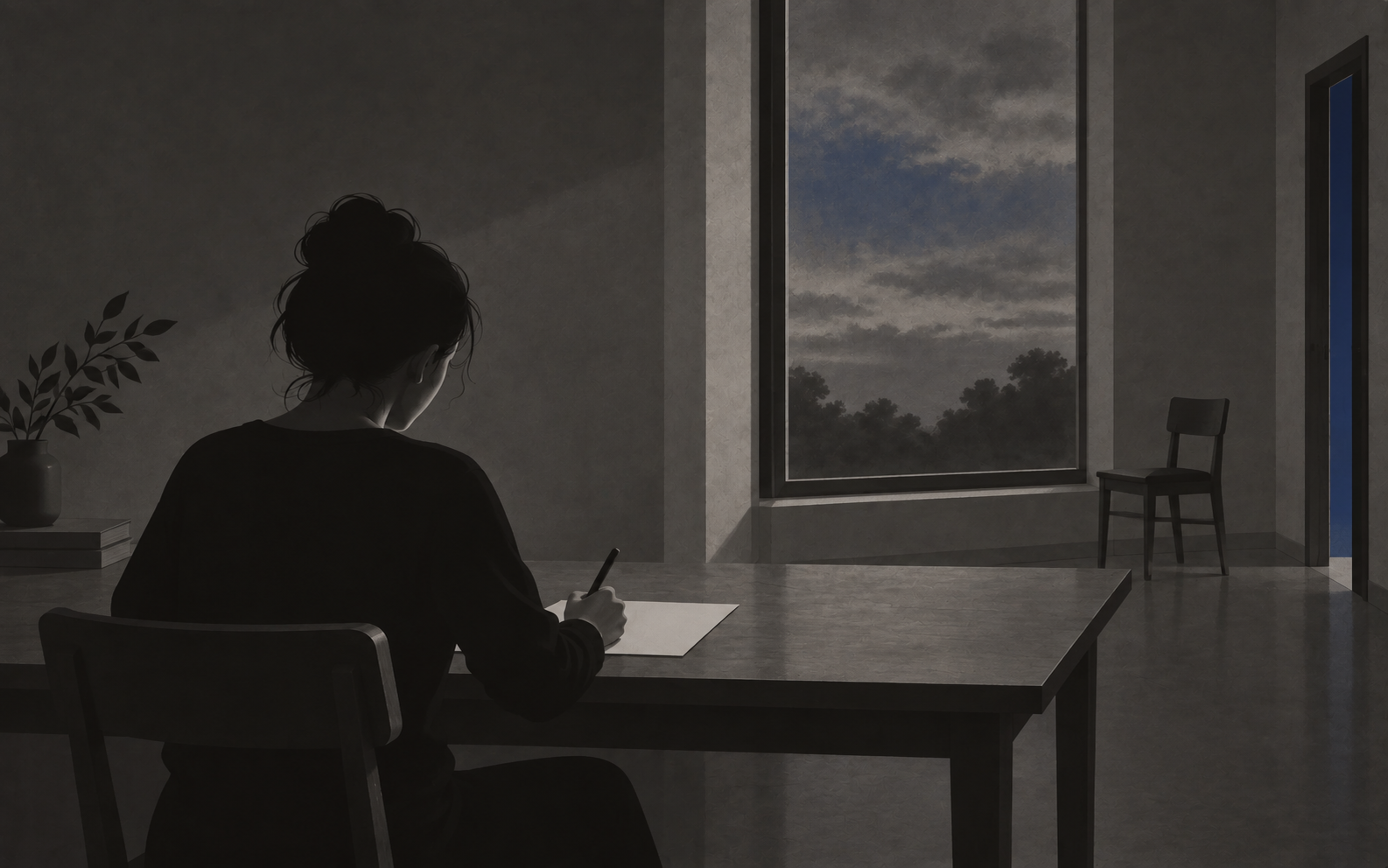
Writing is not only the production of a finished text. It is the work of carrying meaning from one mind to another, while adapting it to a purpose, a reader and a situation.
The invisible work inside a sentence
A new study in Computers and Composition proposes a method for studying writing as a process rather than as a final object. By combining screen recordings, retrospective interviews and reflective journals, the researchers make visible the decisions that disappear when we look only at the finished page.
Those decisions are not decoration. A writer chooses what to explain, what to leave open, which example will travel, and what a particular reader can be expected to know. The same idea changes when it moves from a private note to a public post, from a classroom assignment to a letter, or from one language to another.
This is why writing cannot be reduced to the amount of text produced. The important work often happens before the sentence looks finished: selecting, ordering, imagining, revising and deciding what another person should receive.
A reader changes the shape of the writing
Writing for nobody can be valuable. A private note can preserve a thought before it disappears. But writing for one person creates another kind of discipline. The writer has to make the thought legible without flattening it, and personal without assuming too much.
That is the difference between expression and transfer. Expression asks, “What do I want to release?” Transfer asks, “What can reach the other person?” The second question introduces responsibility, but it also creates form. What Writing Does Before Anyone Answers explores this quieter value of writing: the act can change something before a reply exists.
The rise of generative AI makes the distinction newly visible. A system can produce a fluent text, but fluency is not the same as successful transfer. A sentence may be correct and still fail to carry the writer’s intention to a particular reader. The problem is not only whether a machine can generate language. It is whether the process of deciding what should be said remains visible and meaningful to the person who writes.
The small scale of correspondence
One Reader is built around this smaller definition of writing. A letter is not content waiting to be distributed. It is a message shaped by the existence of one reader, even when that reader is unknown to the writer.
That constraint changes the work. There is no imagined audience to impress, no performance metric to satisfy and no need to make a thought universally shareable. The writer can choose a detail because it might matter to one person, not because it will travel far.
The value of a letter is therefore not exhausted by its delivery. It lies in the transfer itself: the effort to make an inward thing available to another mind without knowing exactly what that mind will do with it.
Writing becomes more human at this scale not because it becomes less technological, but because the technology stops pretending that every message needs to become a product.