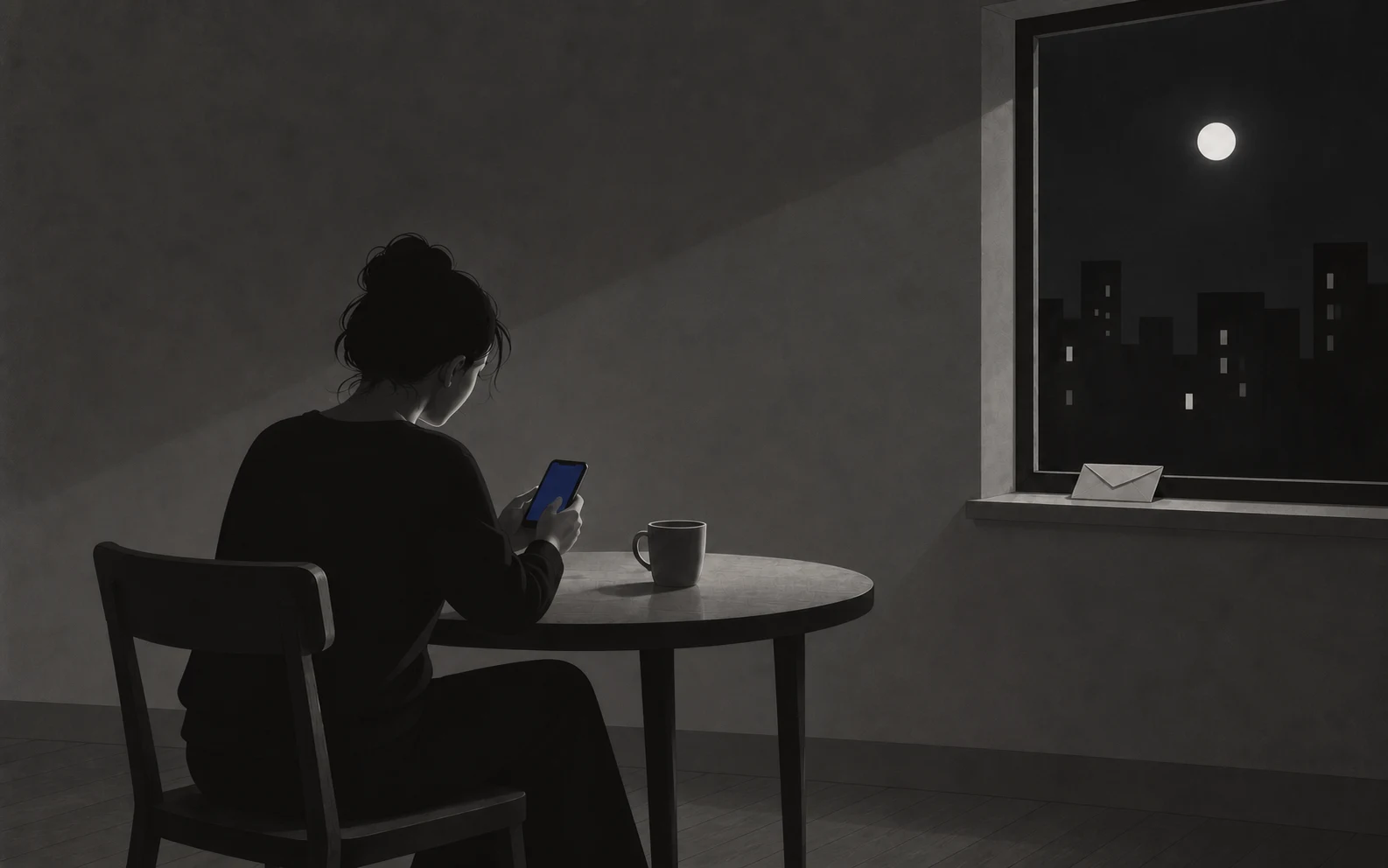
Most advice about quitting social media promises the same thing: more focus, more time, more peace. Nobody warns you about the specific, small silence that follows. Not the absence of news you’re missing, but the absence of people who used to reach you every day and now don’t.
The quiet nobody warns you about
The first week off Instagram or TikTok usually feels good. You notice your hands reaching for a phone that has nothing new to offer, and you feel, briefly, proud of that. But somewhere around week two or three, a different feeling shows up: the group chat that used to be full of shared posts goes quiet. Birthdays you would have known about pass unmarked. People you talked to daily, without ever really talking to them, simply stop appearing in your life.
This is rarely described honestly, because it doesn’t fit the “digital detox success story.” It’s not FOMO, the fear of missing out on information. It’s something closer to being missed out on — by people who, it turns out, only knew how to reach you through a feed.
It’s not the news you lose. It’s who stops reaching out.
Here is the part that catches most people off guard: the friends who stop writing after you leave social media were probably never writing to you. They were reacting to what you posted. A story, a photo, a comment. Take away the feed, and there’s often nothing left to react to.
This isn’t necessarily a comment on the depth of those friendships — plenty of real, warm relationships were also carried, in part, through likes and replies. But it exposes something uncomfortable: a lot of what felt like staying in touch was actually a form of ambient contact, not real correspondence. Once the ambient channel disappears, the relationship has to be rebuilt on purpose, one message at a time, or it quietly ends.
The fix, if there is one, is unglamorous: you become the one who calls, who texts first, who keeps a thread alive on purpose instead of waiting for the algorithm to remind someone you exist. It works, but it also reveals how much of modern friendship had stopped requiring any effort at all.
The other loss: the stranger you’ll never meet
There’s a second kind of loneliness after quitting social media that gets even less attention, and it has nothing to do with the friends you already had.
Social platforms, for all their problems, used to put you in front of people you would never otherwise meet — a stranger’s photo from a country you’ve never visited, a comment thread with someone who thinks completely differently than you do, a small, accidental window into a life unlike your own. Leave the platforms, and that kind of contact tends to disappear too, unless you deliberately replace it with something else.
It’s a bit like the conversation you have with the person sitting next to you on a plane. Culturally, we’ve decided this is almost always an annoyance to avoid — headphones in, eyes closed, please don’t talk to me. But it’s also, often, where an idea for a trip comes from, or a recommendation for a dish you’d never have heard of otherwise, or simply an hour spent in contact with a life completely different from yours, with no algorithm curating who you get to hear from.
Losing your friends’ passive updates is painful in an obvious way. Losing access to the stranger is a quieter loss, but it’s just as real, and almost nobody talks about it when they talk about leaving social media.
What actually fills the space
Filling the first kind of gap (friends) mostly comes down to intention: more direct messages, more phone calls, occasionally being the one who starts the conversation instead of waiting for it. There’s no shortcut. It takes longer than scrolling did, and it works better.
Filling the second kind of gap (strangers) is harder, because there’s no obvious replacement once the feed is gone. Traditional pen-pal culture used to serve this role — writing to someone you’d never met, often across the world, with no shared history and no shared network. Most of that culture has quietly disappeared, not because people stopped wanting it, but because there was no easy way to start.
One letter, one reader
This is the specific gap One Reader is built to fill: not another feed, not another profile to maintain, just a letter written to someone you don’t know, and who doesn’t know you either. No history follows either of you into it. No algorithm decides who you’re allowed to hear from. You write, someone reads, and if they choose to, they write back.
It won’t replace the friends who stopped reaching out — that repair still has to happen the old-fashioned way, one message at a time. But it can replace something social media took away almost as a side effect: the small, occasional, genuinely useful experience of hearing from someone whose life looks nothing like yours.